🔒 This consultation closed at 11:59pm on 4 May 2026.
🏴 It only applied to education policy in England, affecting how different subjects are treated in accountability measures used by the government to assess secondary schools’ performance.
Why should I respond?
The Campaign for the Arts’ analysis has revealed major declines in young people’s access to the arts in schools:
📉 Since 2011, the number of hours of arts teaching has fallen by 23%.1
🍰 Since 2010, the share of GCSE and A-level entries in arts subjects has shrunk by 48% and 31% respectively.2
📚 This is important, as between 2013-14 and 2019-20, on average, between 44% and 57% of 11-15 year olds in England only engaged with arts activities at school, and not outside of school.3
🚧 Furthermore, as the Cultural Learning Alliance has reported, children in the most deprived areas are less likely to study expressive arts subjects or access extracurricular cultural opportunities, creating an “entitlement gap” that limits creative development and social mobility.4
But in November, after years of campaigning, the government pledged to turn this around in their response to the Curriculum & Assessment Review. They committed to:
✨ “Revitalise arts education as part of the reformed national curriculum”.
🔧 End the marginalisation of creative subjects in the way that secondary schools are assessed – scrapping the EBacc and reforming Progress 8.
🌱 Make the arts & culture part of a new entitlement for every child to have access to enrichment activities.5
About the EBacc
The EBacc was introduced in 2010. It measures the number of students entering GCSEs in a specific set of subjects (English language and literature, maths, sciences, geography or history, and a language). Notably, it excludes the arts.
The proposal to scrap the EBacc has been widely welcomed (e.g. by the CLA6, Design and Technology association7, and Creative UK8), following campaigning to have it removed9, as it limited choice and restricted access, resourcing, and time for arts subjects.
About Progress 8
Progress 8 was introduced in 2016. It aims to show how much a secondary school has helped pupils improve (or progress) over a five-year period by comparing pupils’ GCSE results to Key Stage 2 SATs results. It is weighted towards the EBacc subjects, privileging them in a distinct ‘bucket’ ahead of other subjects.
Although many who campaigned against the EBacc also hoped to see Progress 8 abolished, the reform of Progress 8 promised in the government’s response to the CAR could still enable a greater breadth of subjects.
Now, the government has opened a consultation.
🎱 It covers how different subjects – including arts subjects – should be recognised in a remodelled Progress 8.
🚨 While the proposed model represents an improvement, we are concerned that it will not be enough to reverse the decline of the arts in schools.
🧑🏫 This is a crucial opportunity to have our say, and to ensure delivery of the government’s pledge to ‘revitalise arts education’.
What is the government proposing?
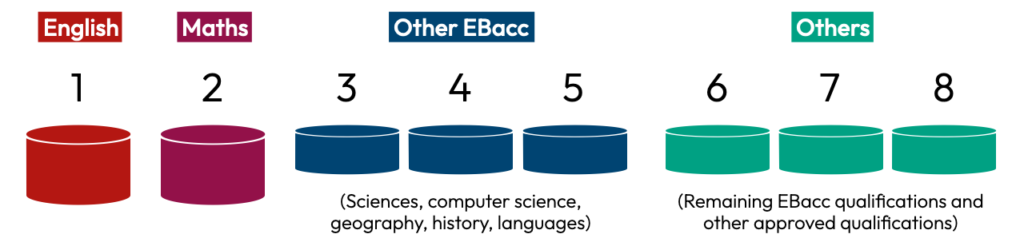
Progress 8 will continue to be based on a calculation of pupils’ performance across eight qualifications.
Currently, it is heavily weighted towards the English Baccalaureate (EBacc), which excludes the arts:
The proposed new model has been restructured to allow creative subjects to be considered on a par with humanities and languages in a ‘Breadth’ bucket, as well as in the ‘Choice’ bucket:
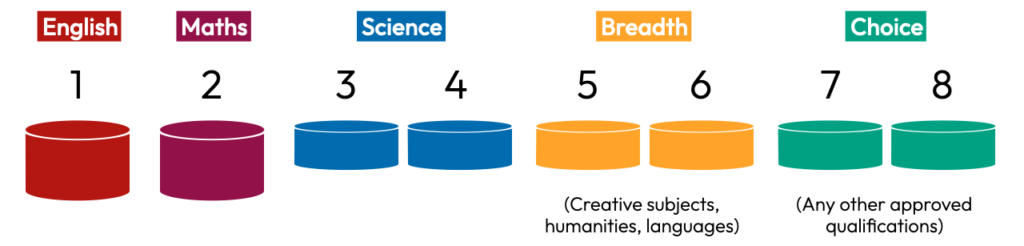
If you’d like more information, please see pages 9-14 of the proposal document and/or the DfE technical guide to the consultation.
How do I respond?
🔒 The consultation was open until 11:59pm on 4 May 2026.
CFTA prepared optional guidance to help you support arts education in this consultation.
Guidance
Page 1 - About you
This section contains questions about you, with options for confidentiality. Please fill this in as you see fit.
Page 2 - Improving Progress 8 and Attainment 8 measures
11. How far do you agree that these changes to the Progress 8 model strike a better balance between breadth and flexibility compared with the current P8?
The proposed reforms elevate the status of arts subjects within the curriculum, but without stronger incentives or structural changes, they are unlikely to significantly increase arts provision in schools and so do not alone meet the government’s stated aim to ‘revitalise arts education’.
- The reforms signal a positive shift by placing arts subjects alongside humanities and languages, potentially strengthening their status in the curriculum.
- However, schools can still meet requirements without expanding arts provision, and given the long decline in arts teaching the easiest option for many schools will be to continue valuing the same subjects, meaning little practical change is likely.
- To genuinely boost arts education, additional measures – such as investment, teacher recruitment, and targeted incentives – will be needed.
Read more
The proposed reforms represent a potentially positive shift from the previous model. By positioning arts subjects alongside humanities and languages within the “breadth” element, the government signals that creative disciplines should carry comparable weight in the curriculum. This recognition could strengthen the hand of arts teachers seeking greater curriculum time or resources, and may also make it more feasible for pupils to pursue more than one arts subject at GCSE.
That said, the wider ambition for arts education to be valued equally within the full spectrum of subjects is unlikely to be realised through these measures alone. As currently designed, the revised Progress 8 framework still allows schools to meet requirements without expanding their arts provision.
Because students can fill the relevant breadth slots with a combination of humanities and languages, the creative pathway can continue to be overlooked. In practice, schools that already prioritise EBacc subjects would face little pressure to change their existing curriculum offer, and could simply continue unchanged.
As offering arts subjects could be seen as costly and challenging for schools, the path of least resistance will likely be not to do so, and simply to have pupils fill their breadth and choice slots from what schools already offer and prioritise.
If the intention is to genuinely strengthen the place of the arts in education, further action will be necessary alongside these reforms. This should include a clear strategy to address the ongoing shortage of specialist arts teachers, increased and sustained investment in arts education, and targeted incentives to ensure schools are able, and encouraged, to deliver a broad and balanced arts curriculum.
12. What are your views on the inclusion of a fourth category (science) for breadth slots 5 and 6?
🔴 We do not support this.
Expanding science into slots 5 and 6 would crowd out arts subjects and weaken the goal of a balanced curriculum.
- Science is already strongly represented in the framework, so expanding it into additional slots reduces space for arts subjects.
- Schools would be even less likely to offer or prioritise arts options if they can default to science which has already been incentivised in the current framework, undermining the aim of a balanced curriculum.
Read more
Introducing science as an additional option within slots 5 and 6 would significantly weaken any gains for arts subjects in the proposed Progress 8 reforms. As discussed above, this reformed model already allows for no arts subjects to be considered, and adding sciences into the categories where they might be will exacerbate this issue.
This is particularly concerning given that science is already well represented in the model, with dedicated slots (3 and 4) and the potential for a third science to be included elsewhere. Expanding its footprint into the remaining breadth options risks crowding out arts subjects altogether.
If the aim is to support a broader and more balanced curriculum, this proposal moves in the opposite direction. It should therefore be reconsidered, as it undermines the stated objective of ensuring that all subject areas, including the arts, have a meaningful place in students’ education.
13. Do you agree that Progress 8 should allow technical awards in the breadth and choice slots, with a maximum of two across all slots?
🟢 We strongly agree.
Including technical arts qualifications in Progress 8’s breadth and choice slots can provide valuable and equal pathways into creative learning and careers.
- This will allow students to select arts subjects such as, for example, the Vocational Award in Performing Arts, Technical Award in Music Technology, Technical Award in Creative Design and Production, among others.
- We believe it is important to ensure parity between academic and technical routes into creative learning and careers.
14. Do you have any comments on the minor methodological adjustment?
We have not responded to this question, which relates to an approach to school rankings.
15. Do you have any other comments on the proposed changes?
Schools have limited resources, and without further incentives and financial support to increase their arts offer, they are unlikely to commit extra money from limited budgets to significantly boost their arts provision.
- Funding pressures on schools have been cited as a major driver of increasingly sidelined arts opportunities for children and young people.
- While there have been recent real-terms increases to the core schools budget, they are unlikely to relieve all of these funding pressures, especially once the costs of expanding free school meals and of rising demand for SEND provision are considered.
- Schools will need substantial funding increases to offer a rich and vibrant arts education to pupils that delivers on the breadth and choice the government’s reform to Progress 8 is intended to enable.
Pages 3 & 4
We have not responded to the questions on these pages, and have left the boxes blank.
Page 5 - Impact
On this page, we have only responded to questions 33 and 35.
33. What impact do you think the proposed changes will have on staff workload or wellbeing?
While the proposed Progress 8 changes could increase uptake of arts subjects in schools that choose to provide more arts engagement for pupils, this will only be sustainable if schools have sufficient specialist teachers, resources, and professional development to avoid added workload and wellbeing pressures.
- Any increase in arts teaching must be met with increases in teacher capacity and school resources to deliver these subjects.
- If teachers are not properly supported, and offered appropriate opportunities for professional development in arts subjects, this will negatively impact workload and wellbeing.
- Likewise if schools do not meet recruitment targets for specialised subject teachers in arts subjects, then this will pose workload challenges for other teachers and/or lead to the removal of provision.
35. Do you have any suggestions for how we can minimise any negative impacts on wellbeing?
A strong arts curriculum depends on recruiting and training specialist teachers, but reduced teacher training bursaries and ongoing recruitment shortfalls in creative subjects risk limiting the workforce needed to deliver the government’s pledge to ‘revitalise arts education’.
- Cuts to Initial Teacher Training bursaries and ongoing recruitment shortfalls in subjects like drama and music are making it harder to attract and retain specialist arts teachers.
- Without sufficient training, recruitment, and support, schools risk lacking confident staff to deliver a high-quality and broad arts curriculum. This may also negatively affect staff wellbeing.
Read more
A broad and robust arts educational offer requires specialist teachers able to expose pupils to a wide range of arts and support their learning with relevant skills and expertise. This will require teacher training, and recruitment. If teachers are not offered adequate opportunities to develop their arts teaching, and if appropriate recruitment does not take place, there will be negative wellbeing impacts on staff.
However, the government has slashed Initial Teacher Training (ITT) Bursaries, removing important financial incentives for individuals training to become teachers in creative subjects.
NFER reports creative subjects continuing to fail to meet recruitment targets, with drama meeting less than half (42%), and music only just above half (65%).10
CFTA has previously said: “Labour has pledged to ‘put creativity at the heart of the curriculum’, but these changes are likely to further restrict the supply of specialist teachers needed to deliver on that promise.”
Teaching staff need confidence to teach arts subjects effectively. This will require investment into meaningful staff support, to prevent negative wellbeing impacts and to empower staff to make the most of this opportunity for expanding the arts in their schools.
Thank you for taking the time to respond to the consultation. Please encourage others to do the same!
- The State of the Arts: one year on, CFTA[↩]
- GCSE and A-level arts entries fall again, to lowest levels since 2010, CFTA[↩]
- The State of the Arts, p76, CFTA[↩]
- Cultural Learning Alliance, Report Card 2025, CLA[↩]
- Curriculum change in England – what’s happening?, CFTA[↩]
- Government response to Curriculum and Assessment Review, CLA[↩]
- Initial Response to Curriculum and Assessment Review, Design & Technology Association[↩]
- Curriculum Review: Creative UK welcomes scrapping of EBacc, but warns against ‘leaving creativity at school gates’ in call to join dots post-16, Creative UK[↩]
- Arts and Minds[↩]
- Worth, J., & Scott, M. (2026). The School Teacher Labour Market in England. NEFR.[↩]
7 responses to “Have your say on Government plans to reform Progress 8”
The PM should know more than others what the arts do for young people, even children, in education. They benefit both physical and mental wellbeing, offering calmness of.mind (through positive concentration), socialisation, discipline, and broadening comprehension. Much research has gone into this, and I hope you cite this in your response.
Art in schools is important, and teachers are aware this talent needs to be encouraged.
It helps students in many ways to see and understand different perspectives in our world, and in day today life.
The Arts are not only instrumental in helping young people to think and analyse issues, at one point for this country they were one of the most important export industries.
Equally I would never want the importance of history and languages for those who can, be overlooked.
I hope the Education Dept/ Govt will look favourably on these subjects.
I am thrilled to hear that it will be changed!!!!
Art is so important, it shapes you as a person, how to express yourself, enjoy colours, shapes, textures and it empower you as a person.
Very many thanks for these helpful suggestions for answers, for doing the work when I don’t have the time to.
Fabulous work you are doing. Thank you
This only begins to address the dramatic shortfall in Art & Design education at GCE level, and especially in History of Art as a subject for critical study as shown in the 2025 AAH Report on Access to Art History at Pre-University Level. If there is in sufficient guidance at GCSE level, where are students to receive any awareness of the value of Art History as a stand-alone area of study, and as a valuable form of contextual study in the wider Humanities?
I just want to make a simple comment about the value of all the arts to everyone. How much they inform us and exercise our ability to observe, ask questions problem solved and gain confidence. Not least to enjoy and maybe relax.